As designers and architects increasingly look for lighting solutions that move beyond basic visual comfort, priorities shift. Ambience, material expression, softness of evening light, human presence in space – these elements begin to define the atmosphere. FlameWarm™ is designed precisely for that moment. Developed by Yuji Lighting, this spectrum-tuned LED technology delivers a deep, fire-like warmth while keeping melanopic stimulation exceptionally low. It is a deliberate, engineered tool for residential, hospitality, wellness, and mixed-use environments.
What is FlameWarm™
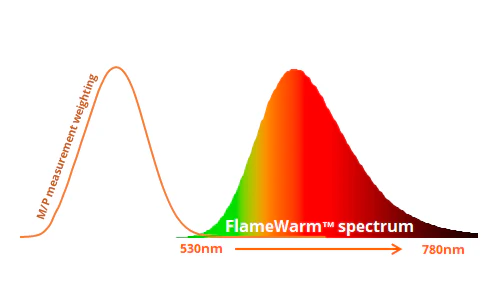
Spectrum range 530–780 nm
FlameWarm™ spans green, yellow, orange and deep red wavelengths with a dramatically reduced blue-light component.
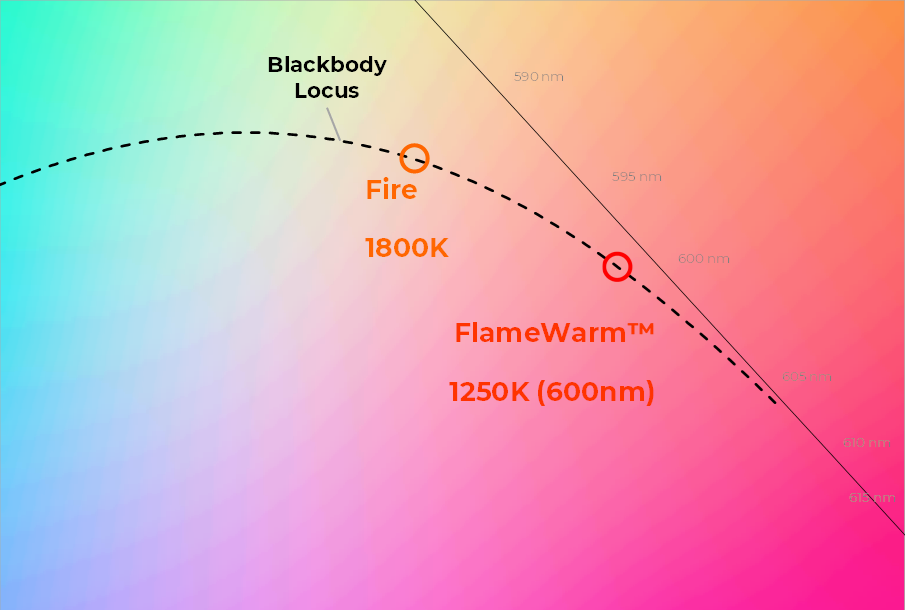
Peak at ~600 nm; perceived color temperature ~1250 K
It recreates the visual character of fire or candlelight without falling into the narrow, monochromatic traps of typical amber LEDs.
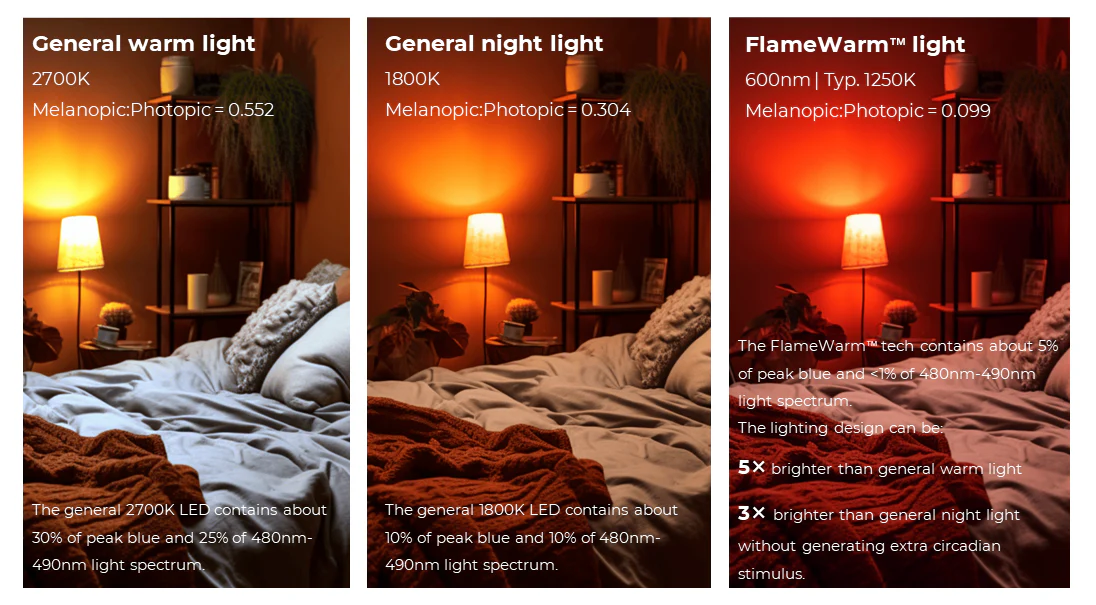
Very low melanopic-to-photopic ratio (M/P ≈ 0.099)
This indicates minimal influence on melatonin suppression and circadian regulation, even at relatively higher light levels.
Broad-band white light (not narrow-band amber)
The spectrum remains rich and continuous, so materials, skin tones, wood and textiles retain believable, nuanced color rendering.
In short: FlameWarm™ is not simply an ultra-warm LED. It is a spectral design approach that combines atmospheric warmth with visual fidelity and biological gentleness.
Blue-Light Reduction and Circadian Stimulus
FlameWarm™ naturally minimizes short-wavelength energy in the 400–500 nm range – the portion of the spectrum most closely associated with melanopic activation and biological alertness. With an M/P ratio around 0.099, the spectrum contributes very little to circadian stimulus (CS) even at moderate illuminance levels.
For designers working on circadian-sensitive projects – bedrooms, wellness areas, luxury hospitality, late-evening environments – this provides a measurable way to support relaxation and pre-sleep conditions without compromising color rendering or the emotional presence of the space. This technical foundation is what allows FlameWarm™ to function not only as an atmospheric tool, but as a biologically considerate one – a rare combination in ultra-warm LED technologies.
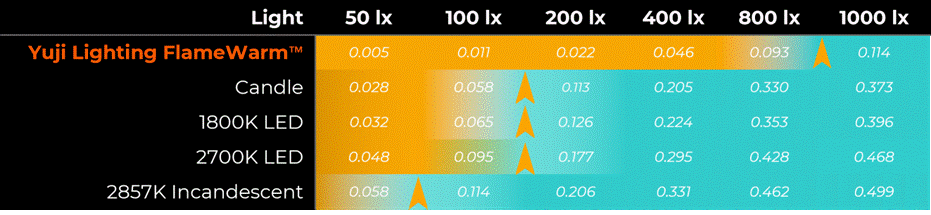
Circadian Stimulus (CS) comparison at equal illuminance levels. FlameWarm™ maintains significantly lower CS values than candles, standard ultra-warm LEDs, and incandescent light sources across 50–1000 lx.
Why FlameWarm™ Matters in Architectural and Hospitality Lighting
Evening and pre-sleep environments
FlameWarm™ works where evening lighting needs to support calm, intimacy and decompression: bedrooms, lounges, spas, hotel rooms, restaurants. The spectrum avoids activating melanopic receptors, helping occupants transition into slower physiological rhythms.
Material and skin-tone fidelity
Broad-spectrum warmth maintains natural, expressive surfaces. Skin retains depth and softness, and materials do not collapse into flat orange or red tints, so FlameWarm™ supports the architectural palette instead of overpowering it.
Smooth integration into layered lighting schemes
In projects with day–evening–night transitions, FlameWarm™ becomes the intentional evening scene. Yuji’s Dim-to-FlameWarm™ products make it possible to move from functional warm white to a fire-lit ambience seamlessly.
Wellness-conscious environments
For clients focused on wellbeing, sleep quality, hospitality experience or sensory comfort, FlameWarm™ offers a lighting mode that is emotionally warm and physiologically thoughtful at the same time.
How to Use FlameWarm™ in Your Projects
FlameWarm™ reveals its full potential when integrated through controllable warm-dimming systems. Yuji Lux offers two options that serve different design intentions: Dim-to-Warm and Dim-to-FlameWarm™.
Dim-to-Warm (3000–1800 K)
Dim-to-Warm is the classic warm-dimming curve many designers know well. As brightness decreases, the light moves into a soft amber tone, creating a sense of closeness and gentle evening atmosphere.
Where it works best
Restaurants, lounges, bar environments
Residential living spaces
Decorative millwork and built-in accents
Public areas expecting traditional warm-dimming behavior
What it offers the designer
A familiar, predictable visual experience
Smooth dimming without abrupt red shifts
A refined evening ambience when circadian concerns are secondary
Dim-to-Warm is the light that shapes mood quietly. It produces warmth without altering the architectural perception too deeply – a good match for elegant, classic evening scenes.
Dim-to-FlameWarm™ (3000–1250 K)
Dim-to-FlameWarm™ belongs to a different category. As it dims, the curve leaves the familiar warm-white region and moves into the full FlameWarm™ spectrum. At its lowest point, it feels like deep firelight – soft, broadband, intimate and physiologically calm.
Where it truly shines
Bedrooms and relaxation zones
Wellness and spa environments
Luxury residential evening scenes
Hospitality spaces requiring intimate, fire-like ambience
Projects where evening light should not interfere with rest or recovery
What it offers the designer
Access to the 1250 K FlameWarm™ spectrum
Extremely low melanopic activation for evening and night (M/P ≈ 0.099)
A fluid transition from 3000 K to a gentle, naturally warm glow
Broadband rendering even at ultra-warm levels
Dim-to-FlameWarm™ changes the emotional temperature of a space with a single dimmer gesture. It slows the environment down, softens interactions, and supports both atmosphere and human physiology.
Choosing the Right Technology for the Right Moment
Design intention | Best fit |
Classic hospitality ambience | Dim-to-Warm |
Fire-like warmth with expressive depth | Dim-to-FlameWarm™ |
Pre-sleep or low-stimulus light | Dim-to-FlameWarm™ |
Decorative or architectural warm accents | Both |
Ultra-warm scenes where color rendering matters | Dim-to-FlameWarm™ |
Together, these two technologies allow designers to structure lighting as a sequence – from functional to atmospheric to deeply relaxing.
References
How YUJILEDS® Dim to Flamewarm™ LED Strips Enhance Sleep with Advanced Spectral Technology, YUJILEDS Webstore
Dim-to-Warm vs. Dim-to-FlameWarm: Why Yuji’s Innovation Reigns Supreme, YUJILEDS Webstore
How to Build a Cozy Lighting Room: A Guide to Circadian Harmony, YUJILEDS Webstore
This article is part of the Human-Centric & Circadian Lighting methodology hub — the framework, melanopic metrics, tools, and spectral platforms in one place.
Choosing hardware for this? See what separates a real 1800K dim-to-warm strip from ordinary warm white.