The concept of wellbeing in architecture has fundamentally shifted how we design interiors. Today, clients increasingly expect buildings to support comfort, daily rhythms, and long-term wellbeing — not only visual appearance. Lighting plays a central role in this shift.
This is not merely a niche design trend — it reflects a broader shift in how the built environment is evaluated and developed. According to newly released 2026 data from the Global Wellness Institute (GWI), the global wellness real estate market reached $876 billion in 2025 and is projected to more than double to $1.8 trillion by 2030. GWI also identifies wellness real estate as one of the fastest-growing sectors of the wellness economy, driven by increasing demand for buildings that support health, comfort, and daily wellbeing. For architects, developers, and lighting designers, this creates a clear professional opportunity: wellbeing is becoming a measurable part of spatial value, not just a lifestyle narrative.
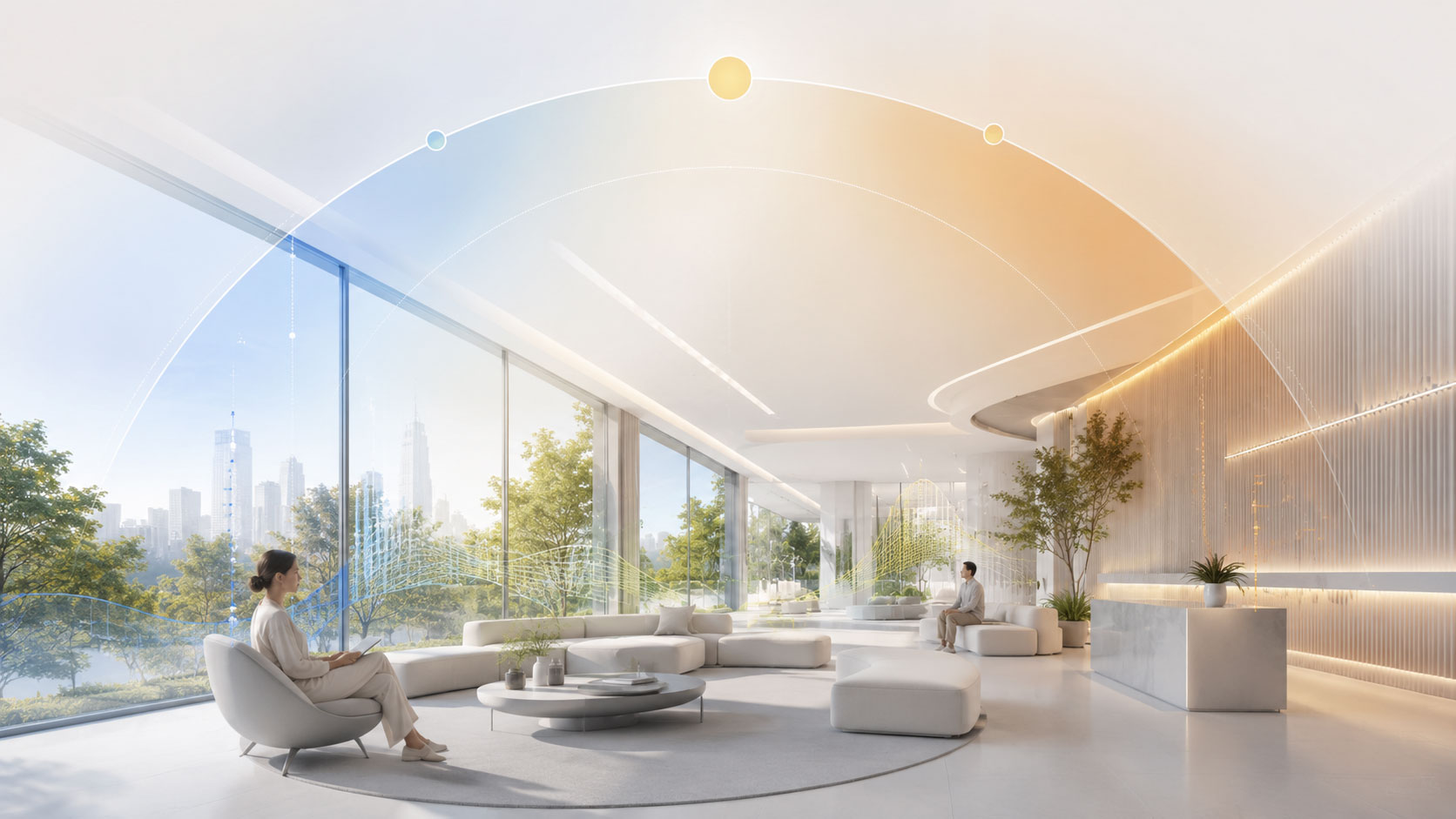
However, as consumer demand for wellness grows, so does the risk of "healthwashing." The term Human-Centric Lighting (HCL) is increasingly used as a pseudo-scientific marketing label. Architects are often presented with basic Tunable White systems as a panacea, overlooking a critical physiological fact: Correlated Color Temperature (CCT) alone is not a reliable metric for the biological effectiveness of light.
True circadian lighting design is a holistic discipline that requires a deep understanding of both visual and non-visual effects of light. Achieving this level of precision requires more than standard LEDs; it demands mastery over the light spectrum itself. As a pioneer in advanced phosphor technology and full-spectrum illumination, and a member of the Good Light Group Asia, Yuji adheres to a rigorous scientific approach. In this guide, we explore how spectrum, timing, and intensity form a healthy environment and which tools help you integrate effective wellbeing scenarios into architectural projects.
How Light Controls Us: The Science of Non-Visual Effects
To create human-centric spaces, designers must look beyond aesthetics. Light exerts a powerful influence on our endocrine system, primarily by regulating the production of melatonin and cortisol—a process known as circadian entrainment.
It is a common misconception that simply shifting from cool to warm light is enough to sync our biological clocks. Science dictates a more nuanced hierarchy of variables. According to recent research, the biological impact of light depends on:
Temporal Pattern: The timing and duration of light exposure.
Intensity: Specifically, vertical illuminance at the eye level, measured in mel-EDI (Melanopic Equivalent Daylight Illuminance).
Spectrum: The Spectral Power Distribution (SPD) and its specific wavelengths, rather than just CCT.
Design Benchmarks: WELL v2 and UL DG 24480
For the US market, HCL and circadian lighting strategies are often evaluated through quantitative design frameworks. These benchmarks should be treated as reference methods rather than universal recipes: targets vary by space type, user profile, schedule, daylight contribution, and certification pathway.
WELL Building Standard v2: includes circadian lighting criteria based on Equivalent Melanopic Lux (EML), with targets that vary by application and space type. In some use cases, WELL references 250 EML at the vertical eye level; in others, the required exposure and calculation method may differ.
UL Design Guideline 24480: is a design guideline rather than a mandatory standard. It uses the Circadian Stimulus (CS) method and commonly references a daytime target of CS ≥ 0.3 for a defined morning exposure period to support circadian entrainment in day-active people.
For designers, the key implication is that circadian lighting cannot be specified through CCT alone. It requires coordinated decisions about spectrum, intensity, timing, spatial distribution, daylight integration, and the way light reaches the eye on the vertical plane.
Simplified Circadian Design Framework
Phase | Design Intent | Indicative Light Exposure Direction | Spectral Strategy |
Morning/Midday | Alertness & Entrainment | Higher vertical melanopic exposure; target depends on the selected WELL/UL pathway | Daylight-like spectrum with strong visual quality and controlled glare |
Early Evening | Transition & Relaxation | Reduced melanopic exposure and lower overall intensity | Warm, visually comfortable light with limited short-wavelength content |
Pre-Sleep | Melatonin Support | Very low melanopic exposure; avoid bright light at the eye | Amber-rich, low-M/P spectrum for restorative evening scenes |
These directions are intentionally simplified. Final project targets should be verified through project-specific calculations, daylight analysis, user schedules, control logic, and the applicable certification or design framework.
What This Means for LED Specification
For architects and lighting designers, the practical question is not whether a luminaire can shift from warm to cool. The question is whether the LED system can deliver the right spectral composition at the right time while preserving visual comfort, color quality, and consistency across the project.
Daytime scenes need sufficient melanopic impact without creating overlit, uncomfortable interiors. Evening scenes need a deliberate reduction of short-wavelength content, not simply a lower CCT. This is where spectrum, dimming behavior, diffuser and profile selection, and control strategy must be considered as one system.
A Yuji SunWave™ daylight simulation scenario visualizing the daily changes in light intensity, spectral distribution, color rendering, and melanopic daylight efficacy ratio:
Daytime Activation: Daylight Simulation with SunWave™
Many Tunable White systems can create a basic shift between warm and cool scenes, but not all maintain spectral continuity, color stability, or predictable visual quality across the full dimming and tuning range. For daytime activation, architects need LED solutions that combine high melanopic efficiency with reliable color rendering and stable architectural appearance.
SunWave™ is designed for this type of daylight-oriented application. Based on Yuji’s proprietary phosphor formulations and full-spectrum LED technology, SunWave™ can support daylight simulation strategies with a spectrum that closely follows natural sunlight.
Precise Daylight Simulation: It supports high melanopic efficiency for daytime scenes while maintaining strong visual performance.
Architectural Consistency: The system is intended to preserve color quality across the 2700K–6500K range, helping designers avoid unstable intermediate scenes.
Applications: Ideal for offices, schools, and commercial interiors where visual stability and biological activation are paramount.
Evening Relaxation: The Ultra-Low Melanopic Impact of FlameWarm™
Evening lighting is about more than just warm tones. Most standard 2700K LEDs still contain enough short-wavelength (blue) light to suppress melatonin production.
To design a truly restorative environment, the spectrum must be "circadian-considerate." Yuji’s FlameWarm™ reaches an exceptionally low Melanopic/Photopic (M/P) ratio of 0.099 — lower than candlelight.
You can learn more about the physiology of this technology in our dedicated article on FlameWarm for hospitality and residential lighting.
For dynamic spaces, the Dim-to-FlameWarm™ solution offers:
A Controlled Spectral Path: Moving from Daylight Relax Mode (3000K) to the deep amber FlameWarm™ Mode (1250K).
Seamless Integration: Using a single 2-pin circuit, it mimics the natural descent of a sunset without abrupt jumps in color.
Conclusion: A Holistic Lighting Ecosystem
The future of architecture lies in spaces that actively support human health. Circadian lighting design cannot be an afterthought; it is an integral architectural system where natural and artificial light work in synergy.
Creating these spaces requires moving beyond standard off-the-shelf lighting. It demands lighting solutions built on fundamental spectral science. With years of pioneering R&D in high-CRI and advanced phosphor technology, Yuji empowers designers to execute uncompromised HCL designs.
By leveraging science-based tools like SunWave™ for activation and FlameWarm™ for relaxation, designers move from merely specifying products to creating holistic lighting ecosystems. This approach doesn't just illuminate a room—it enhances the physical and emotional quality of life for everyone within it.
Yuji Lux works directly with architects and lighting designers to define circadian targets and evaluate complete LED assemblies. If your project requires true, science-based Human-Centric Lighting, contact Yuji Lux to discuss the right spectral strategy.
Further Reading
Circadian lighting for architects and designers — the complete guide: melanopic metrics, WELL v2 targets, and specification language.
The Winter Light Protocol: how much daylight your city loses by December, with a daylight-deficit calculator.
How melanopic EDI is measured — the verifiable metric behind circadian specifications.
This article is part of the Human-Centric & Circadian Lighting methodology hub — the framework, melanopic metrics, tools, and spectral platforms in one place.